Is AI stealing your leads? Here’s how to generate your own demand


Are your site traffic and leads being swallowed up by AI-assisted search? Explore how you can adapt your approach by pairing lead generation with demand generation techniques.
If you’ve noticed a subtle (or not-so-subtle) drop in your search traffic and the resulting leads in past months, you’re not alone. Almost 60% of searches now end without a click.
AI-assisted search and answer engines are growing in popularity as people take advantage of their quick, consolidated results to get what they need. Even social search is on the rise, with some users able to follow an in-app trail from research to purchase without ever straying onto an external website.
That’s great for users. But it also means that more and more content is being absorbed into ‘AI Overviews’ instead of drawing people to your site to explore your carefully curated user journey.
Early research into this suggests that people who encounter an AI summary are nearly twice as likely to end their session without clicking a link than those who see a normal results page.
In this environment, old-school lead generation techniques are losing effectiveness. So what can we do about it?
Content just isn’t converting like it used to
Write content. Get clicks. Capture leads.
This straightforward, traditional model of lead generation is fading fast, replaced by zero-click interactions.
“Generally, people prefer to find their own way when they’re researching products or services – and that’s great for lead gen,” says Michael Morrell, CEO at Mediahawk. But with AI taking the workload out of it, fewer people are exploring content, visiting product pages, or downloading gated assets.
That means fewer leads to pass on to sales or log in your CRM, and less data to work from. If people never land on your website, tracking and attribution can break down.
Without those touchpoints to help you gauge interest and engagement, monitoring performance and demonstrating the ROI for your efforts gets even harder.
“There’s a chance that the people who do land on your website will be high-intent individuals who are ready to mark themselves out as a lead by heading straight to make a call, book a demo, or fill in a contact form,” says Michael. “But you can’t rely on a motivated few to keep your pipeline full – you need to find new ways to bring in leads.”

Generate your own demand instead
 Lead generation is about capturing existing interest – converting people who are already in the market.
With demand generation approaches, you’re playing the long game. You’re building up your profile and establishing trust with the kind of people you want to sell to later down the line. In an ideal world, they won’t even have to research when they’re ready – they’ll just come straight to you.
“Demand generation is all about reaching people earlier in their journey,” says Michael. “Perhaps they haven’t even thought about needing you yet. Wherever your ideal customers spend their time, that’s where you want to be visible.”
Demand generation comes in many forms
Demand generation doesn’t have to be strictly ‘about you’ to be effective. Keeping this higher-level content focused on big themes in your industry and the challenges your prospective customers want to solve can help establish you as a trustworthy voice.
Regular emails, social posts, and even direct mail are simple, effective ways to do this. But the more you put in, the more value you’ll get back, so you can also consider more involved approaches such as:
- Educational content: Challenge-led blogs, ebooks, and research reports that offer ungated, no-strings-attached advice show you’re switched on to the needs of your audience and ready to help. If you can conduct your own first-party research, even better, as it’ll give you data you can use in loads of different ways.
- Partnerships, communities, and influencer content: Making connections with likeminded businesses, influential groups, and popular figures in your sector unlocks more places to share content and more topics to explore. Guest posts and podcasts are great examples.
- Interactive and user-generated content: Not all your demand generation content has to come entirely from you. Fireside chats and webinars provide spaces to ask questions and learn, while social media offers the perfect opportunity to encourage people to share experiences and feedback.
And the best news is that all your lead generation content – your product brochures and deep-dive white papers – are still there waiting for your new prospects when they do eventually land on your site.
Smarter measurement in a multi-channel environment
As it’s so diverse, demand generation naturally lends itself to activities across the full range of channels available. To keep your efforts (and spend) focused for both demand and lead generation, you’ll want to keep a close eye on what’s most successful for your organisation. A renewed focus on attribution and marketing analysis can help you hone your channel mix and build a clear picture of what high-quality engagement looks like.
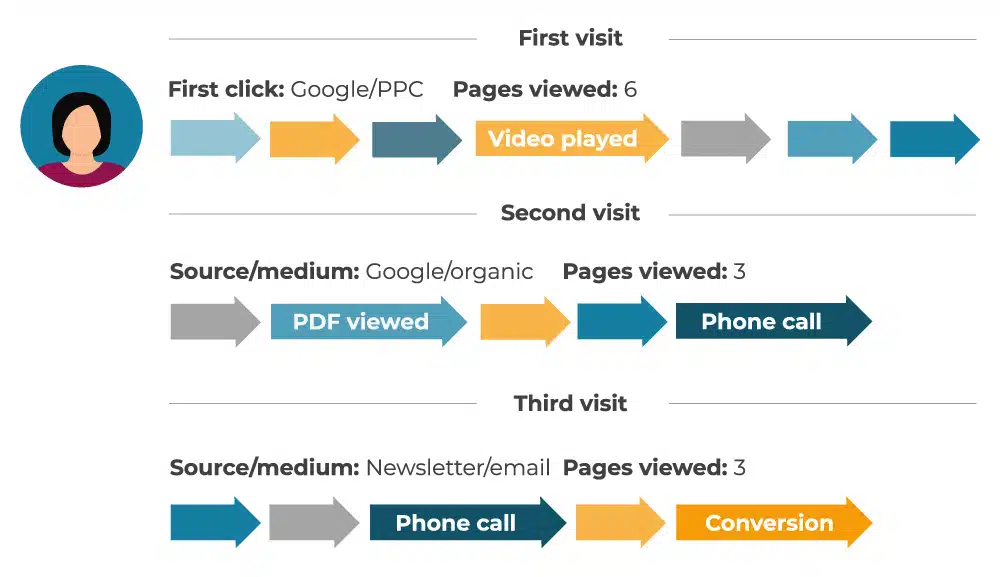
Track your website visits and calls to see which channels deliver the most promising prospects, so you know where your communities are most active. And you can use speech analysis to uncover the most popular topics and queries when people call you. This doesn’t just give you insight into the user journey, it also helps feed your demand generation work.
When you know what people want to talk about, and where their unanswered questions lie, you can cater your content to those needs.
“Strong attribution links demand and lead generation tactics to revenue,” says Michael. “This helps organisations pivot from a relentless focus on volume to prioritising the quality of engagement and interactions. Investing upfront in education and trust building means you’re more likely to bring in high-quality leads.”
Summary
AI Overviews and assistants may be stealing attention away from your traditional lead generation routes, but that doesn’t mean the technology has to be your enemy.
If you adapt your strategy and content to supplement lead generation with demand generation, you can secure a long-term pipeline of prospects.
And you can put AI to work too. It’s proving valuable throughout the marketing workflow, freeing up time for marketers to evolve their strategy for this new environment. It’s especially useful for analytics – perfect if you’re experimenting with new demand generation techniques.
In our 2024 ‘State of call tracking report’, we included AI in our list of potential martech tools for the first time. More than a third (38%) said it was part of their marketing mix. And when we asked in this year’s survey it had already risen to 51%, and we expect that percentage to keep climbing. It’s all about finding the right use cases.

Explore how you can use AI to create better content, analyse results, and improve campaigns in our ebook, where we break down three key types of AI and how they can transform the daily marketing workflow.