The shift to answer engines: Adapting to a new era of search


Search is shifting into something new. Gartner predicts that by 2028, 25% of people will use AI assistants as their first point of search. Not Google, not Bing, but tools designed to give answers instantly.
We’re already seeing this play out. More than half of Google queries end without a click, while answer engines like Google’s AI Mode, Perplexity, ChatGPT, and Bing Copilot are gaining traction by cutting straight to the response.
For marketers, this means the old playbook of optimising purely for clicks is under pressure.
The wider move towards answer engines is reshaping how people find information – and how marketers need to think about visibility, attribution, and measurement in a world where a click is no longer guaranteed.
What are answer engines?
“Unlike traditional search engines that serve up a list of links, answer engines provide a direct response,” says Faye Thomassen, Head of Marketing at Mediahawk. “Ask Perplexity a question, and you’ll get a conversational answer with sources. Use ChatGPT, and you’ll get a summary or solution, often without ever clicking a link. Even Bing and Google are shifting from ‘ten blue links’ to AI-generated answers – all with the ability to refine your query on the spot.”
For example:
- Google traditional search engine: “Here are 10 pages about summer smoothies.”
- Google AI mode: “Here’s a simple smoothie recipe you can make in five minutes.”
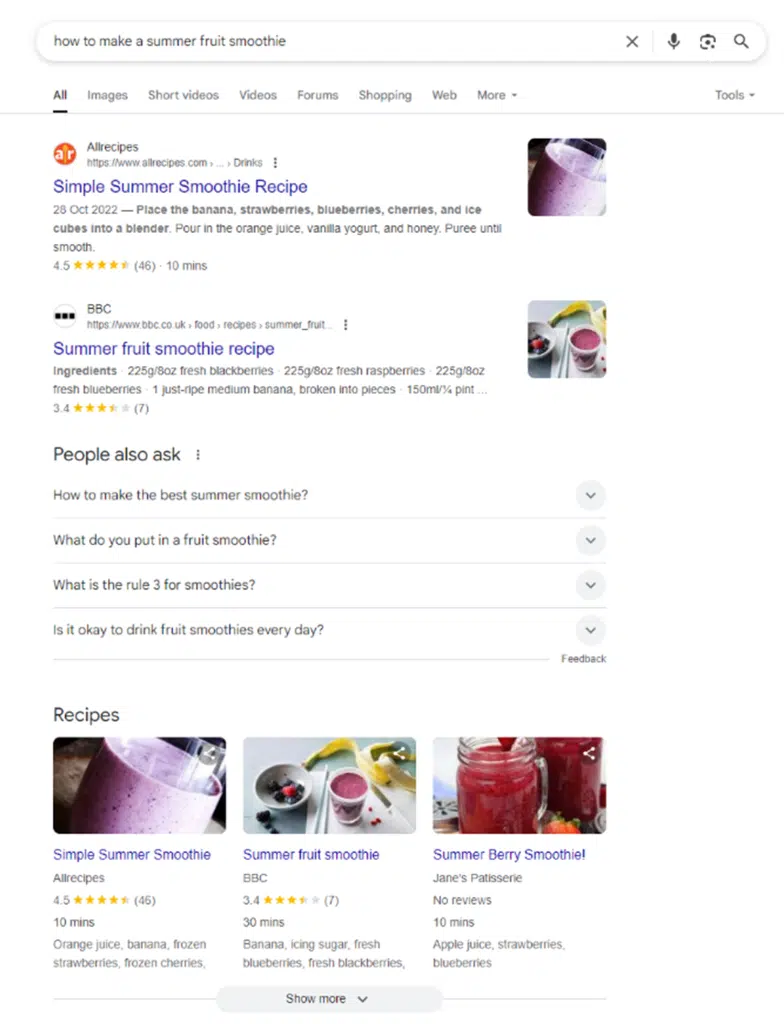
Screenshot showing the Google tradition search engine results page for the query: “how to make a summer fruit smoothie”
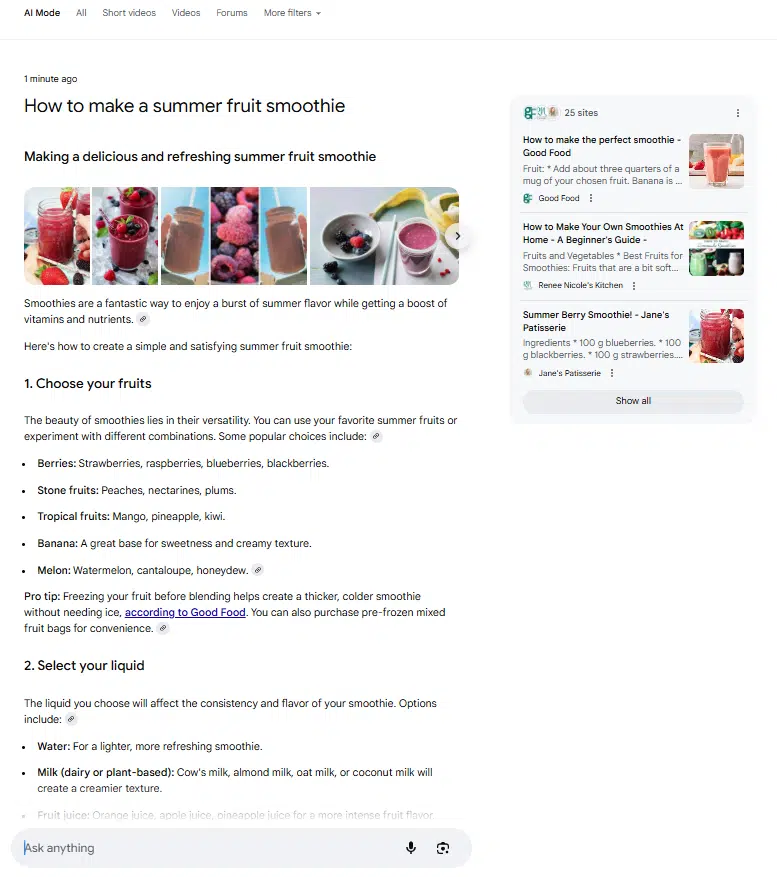
Screenshot showing the Google AI mode results page for the query: “how to make a summer fruit smoothie”
The appeal for users is clear: speed, simplicity, and less digging around on websites. For marketers, it’s trickier because fewer clicks means fewer chances to capture that all-important visit.
Why answer engines matter to marketers
- Google’s AI Overviews now reach over 1.5 billion users monthly, signalling just how mainstream AI summaries have become.
- Google’s AI mode is rapidly expanding too. It has now rolled out in 12 countries, been activated by 80+ million users, and has grown nearly 200% in just six months.
- On the competition front, ChatGPT handles about 9% of global digital searches and records much longer session times than Google, indicating deep user engagement.
If people are getting instant answers without clicking through to your website, it doesn’t mean your business disappears. It means you need to think differently about visibility and impact.
Some answer engines cite sources, while others may paraphrase content without a link. Either way, measuring the value of your campaigns becomes harder when the traditional click-to-visit path is broken.
“This is where analytics and attribution come in,” adds Faye. “By tying together multiple touchpoints throughout the user journey – from the first search to the final call or online enquiry – you can still prove the role your marketing plays, even if the journey looks less linear than before. Call tracking, for example, lets you see which campaigns are driving real conversations, not just clicks, helping you close the gap between what happens on an answer engine and what happens in your business.”
How marketers can adapt to answer engines
In response, marketers are turning to Generative Engine Optimisation (GEO) and Answer Engine Optimisation (AEO) – from structured markup to llms.txt files – to be cited in AI-generated answers.
Here’s how to make sure you’re still showing up:
1. Be present in answer engines and AI Overviews
It’s not just about ranking in the search engine results pages (SERPs) anymore. You need to be looking at ways your website and resources can actively appear in answer engines and AI Overviews.
Also, keep an eye on emerging opportunities like Answer Engine Ads while competition is still low.
2. Make sure your website is answer engine-ready
Answer engines need structured, trustworthy content to appear for queries. Focus on:
- Content: Write pages that directly answer customer questions, in clear language. Keep your pages updated, and refresh them regularly.
- Tech setup: Use schema markup and semantic tags, keep your site fast, and consider implementing an llms.txt file to guide AI crawlers (it’s important to note that it’s still early days for this, and not being formally picked up by the major answer engines).
- Authority: Show expertise with author profiles, up-to-date research and information, and citations from high-authority sites.
3. Understand the whole user journey
“Clicks aren’t disappearing completely, but they’re only part of the picture now. Many enquiries will come through ‘dark’ routes, where someone sees your answer in an engine and calls without visiting your site, for example”, explains Faye.
“Call tracking, marketing analytics, and attribution are key here. They let you link enquiries to the channels and touchpoints that influenced them, even when there’s no obvious digital footprint.”
How to track and analyse performance from answer engines
The rise of answer engines doesn’t mean traditional SEO or PPC stops mattering – far from it. But it does mean you need to expand how you measure and optimise. Some practical steps are:
- Monitor visibility in answer engines: Track when your brand is cited in AI Overviews or answer engine results, even if you don’t get the click.
- Use trackable assets: Use attribution tools and call tracking to understand where leads really start. UTM tags, trackable phone numbers, landing pages, and QR codes, for example, give you clearer attribution.
- Optimise beyond the click: Create content that answer engines can surface (clear, authoritative, well-structured), but make sure you’re tracking the outcomes that matter, such as calls, conversions, revenue, and ROI.
- Analyse ‘direct’ traffic and offline engagement: Combine web analytics with Speech Analytics to uncover the real intent behind enquiries and measure the uplift from AI visibility.
- Bring it all together: Marketing attribution tools can connect fragmented journeys – from an AI mention to a direct call – giving you a clearer picture of performance and ROI.
- Stay flexible: Tools like Google’s AI mode are evolving quickly. What works today may not tomorrow.
Some answer engines automatically add utm_source tags to the links they show. These tags make it possible to see exactly where traffic is coming from. By capturing these tags in your tracking setup, you can continue to monitor the source of enquiries, ensuring your attribution data stays accurate even when traffic comes through new channels like answer engines.
Conclusion
The search landscape isn’t vanishing – it’s transforming. Answer engines are cutting down the journey from question to answer, and that means marketers need to measure success differently.
If you can adapt your tracking, marketing analytics, and attribution to follow the outcome, not just the click, you’ll stay ahead – no matter which engine your audience is using.

Learn how Mediahawk gives you the attribution clarity you need. Book a personalised demo today.