Transaction-Level Measurement: Improve Marketing Performance & ROI

Written by Michael Morrell

Transaction-level measurement improves marketing performance by providing granular data on lead sources, customer interactions, and revenue generated, allowing for precise budget allocation and optimization within and between channels. Unlike company-level ROI, which only shows overall direction, transaction-level data offers the 'steering wheel' to understand exactly why performance changes and how to adjust strategies effectively. This detailed insight helps identify multi- and inter-channel influence, refine experiments, and future-proof lead management processes by capturing comprehensive transactional information against every lead and opportunity.
They said, “Measuring marketing performance is practically the same”…
You see, if you use ROI and Customer Acquisition Cost (CaC) at a company-level you’ll know if you’re going forward or backward, perhaps getting better, perhaps getting worse. ROI was 90% this quarter and 50% last. Performance is better but, let’s face it – you don’t honestly know why.
Using ROI like this might keep you in a job if it’s heading the right way. It might cost you your job if it’s not. If it’s not, how are you going to change direction?
Measuring channel-level and transaction-level performance opens your eyes and gives you a steering wheel to control your direction.
Why is attribution important for marketing performance?
Attribution is crucial for marketing performance because it allows for a deeper understanding of how different channels and touchpoints influence results, moving beyond simple channel-level measurement. While channel-level data helps allocate budget between channels, true attribution, especially at the transaction-level, reveals the exact relationships and interactions within and between channels. This granular insight, gathered by tools like Mediahawk, enables marketers to optimize budget allocation, refine strategies, and avoid prematurely dismissing entire channels, ultimately leading to more effective marketing spend and improved ROI.
At a stroke you can move budget from poorly performing channels and start controlling your direction of travel.
This is just the beginning of the journey, and the one thing I have learnt over the years is that the more you improve, the hungrier you are to improve.
Simply moving budget between channels risks tipping the baby out with the bath water. It’s unlikely that channel is all bad. You need to understand exactly what is happening within the channel, what the relationship is between channels, and how the channels work together to influence results.
This requires a little more data at the transaction-level. Tools like Mediahawk gather this information, report on it, and pass it on to your other marketing systems. By capturing one simple Mediahawk reference in your CRM, we’ll provide chapter and verse on which search terms telephone callers used to find you, which other content and channels they interacted with, which pages they visited, which emails they read, and much more.
Transaction-Level
- Measure CaC and ROI at the transaction level
- Budget allocation within and between channel, e.g. at the keyword level
- Experiment and refine
- Identify multi- and inter-channel influence
Channel-Level
- Measure leads at a channel level to understand which channel are most effective
- Allows marketing to allocate budget and effort between channels only
- Doesn’t fix problems within a channel
Company-Level
- Allows the company to see general marketing effectiveness
- Can measure the overall direction of travel
- Will not indicate which areas need improvement, so risk relying on a fickle channel to deliver leads
Mediahawk is packed full of tools to help capture data at the transactional-level
Live calls (real-time) report
The Live Calls (real-time) report provides immediate access to transactional information for every incoming call, allowing you to capture a single ID in your CRM system. This ensures every piece of transactional data Mediahawk offers, related to live calls, is available against each lead and opportunity, enabling real-time insights into call-driven interactions.
Source flow report
The source flow report takes the effort out of understanding inter-channel influence. It analyses every visit, interaction, and call-to-action, and shows you exactly which combinations of visitor touchpoints are most likely to generate an interaction:

Attribution report
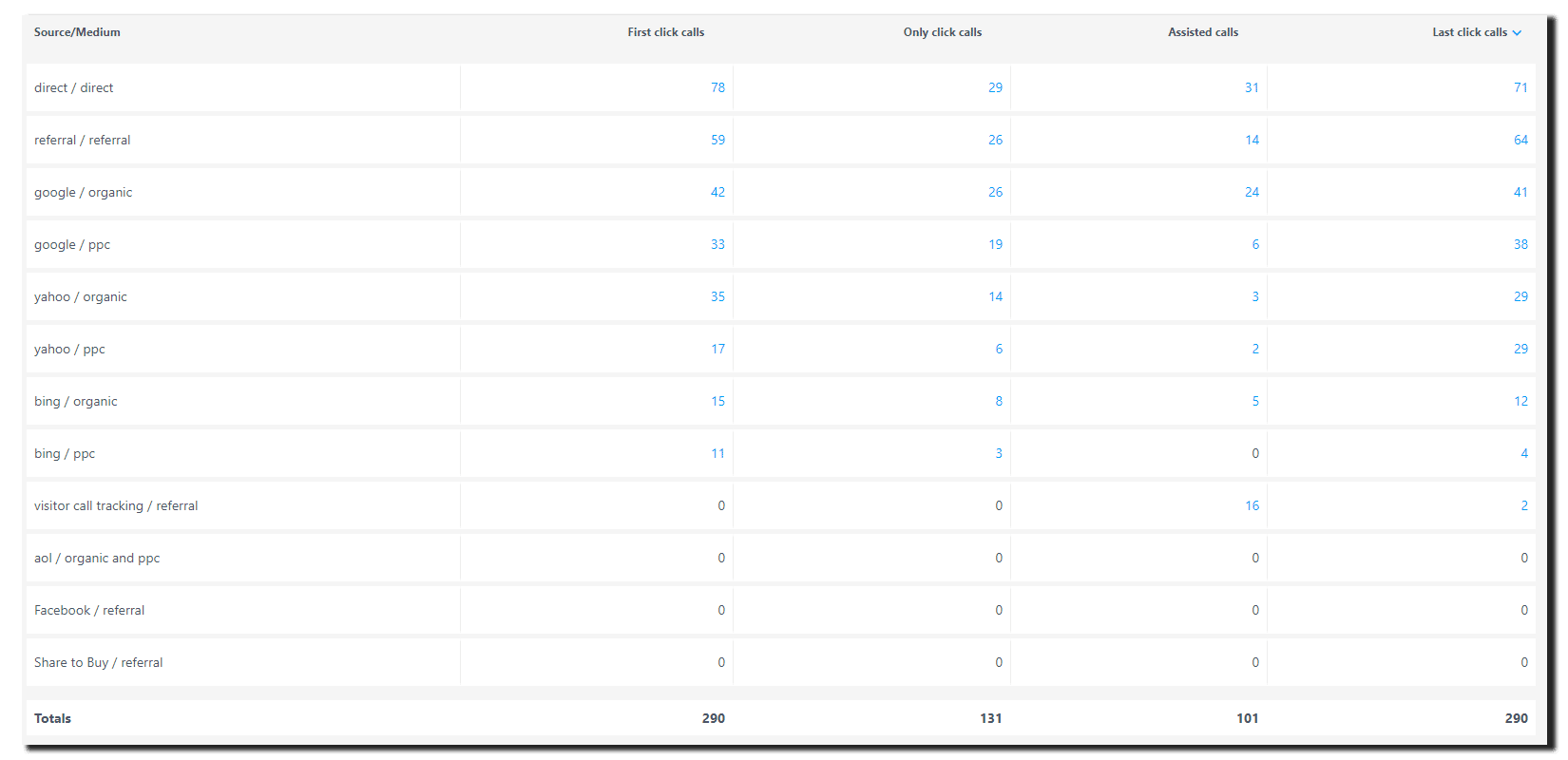
The attribution report shows you whether a source ‘influenced’ an interaction – regardless of the whether it was the first or last click. Great for understanding whether channels such as paid search are performing well:
These tools make it very simple to add a little more detail at the point a lead is captured. However, they go a very long way towards improving your understanding of marketing performance.
By capturing this information, you’ll future proof your lead management processes. For example, if in the future you decide to analyse your opportunity pipeline by a particular media source or referring website, you’re able to – purely because you are recording a small data snippet at the transaction-level.