SEO for phone calls: How to drive high-intent call traffic


In today’s digital-first world, phone calls almost seem primitive compared to more modern online channels. But they still have a vital role to play for businesses, often signalling higher intent over the likes of form fills and clicks.
That said, traditional SEO is usually geared towards increasing clicks, not calls. Here at BANC, as a digital agency, we’re always seeking out new ways to keep our clients growing, we’ve seen an increase in business calls they receive from people with high levels of interest and intent thanks to “call-driven SEO”. It’s a hugely valuable approach that businesses can leverage, turning traffic into inbound calls from users ready to work with you.
So, how can you get your website to do the same for your business? Let’s show you. Below, we’ll look at the methods that go into increasing the number of calls to your business from qualified leads in more detail.
Understanding high-intent call traffic
When we talk about high-intent call traffic, what do we mean exactly? Simply, it’s traffic from users who are generally ready to buy or have specific queries in mind. They’re the people typing emergency electrician near me or speak to a lawyer about injury claim into Google, who want to move beyond browsing.
These users prefer picking up the phone because it’s often a faster process. Their queries are complex, better suited to human interaction with someone with the knowledge to meet their needs. And since they’re at the bottom of the funnel, they’re usually ready to go from lead to conversion.
The role of SEO in driving phone calls
There’s a strong link between calls and SEO. For one, organic search has a powerful influence on our call behaviour. Mobile search means users are already on their phone. Click-to-call features in SERPs make connecting to a business without the need to even visit their website quicker and more convenient than ever.
Then there’s local SEO. Locality remains a huge driver for telephone inquiries, so optimising your Google Business Profile is always a good idea, as is using location-specific keywords across web content. They don’t just help from a search perspective, they’re a great trust builder too, showing that your business is a convenient, helpful option for those in the local community. We’ll touch on how you can do this in more detail later.
How AI has changed the use of organic search for phone calls
The customer journey for phone calls made from AI search tends to look like this:
- AI discovery: A person asks an AI search tool for a local business or service.
- Validation: The AI recommends one or more options, which the user then checks against trust signals like reviews or maps.
- Action: The user clicks or calls to convert.
Because AI search compresses what was several search steps into one answer, the journey differs from classic SEO. Now, there’s less need for users to visit different websites for an answer, in theory at least. For businesses, that means the job is no longer just to rank in search, but so that AI can easily find, summarise and trust them across directories, reviews and business profiles.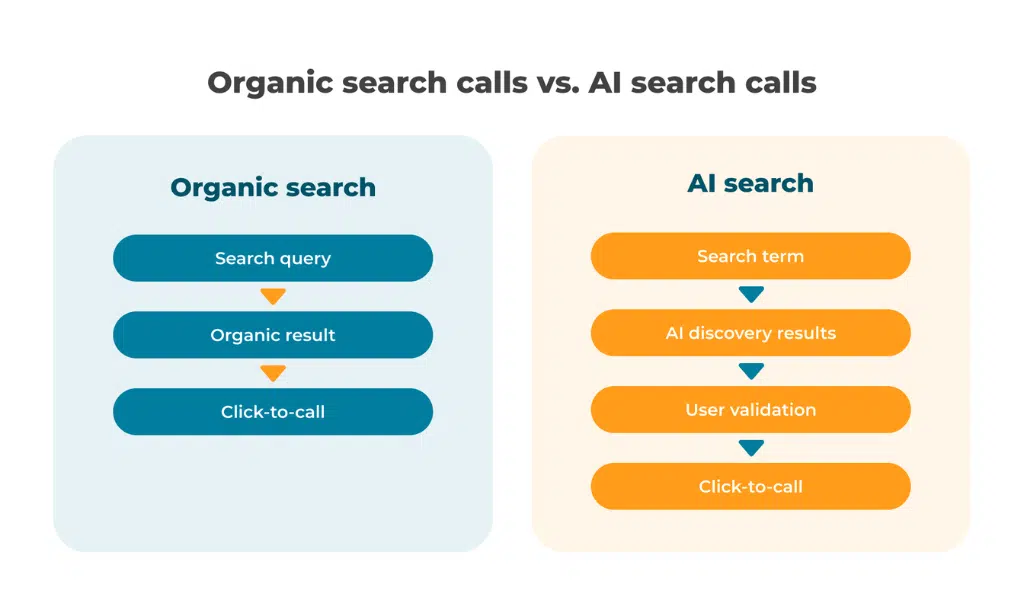
Creating an organic search strategy to drive high-intent calls
So what can you do to drive calls to your business? We’ll run through some effective approaches to implement into your organic strategy.
Organic search strategy
What kinds of high-intent search terms will the user plug into Google? The answers here fuel content ideas that cater to their specific needs, such as creating service pages which highlight the urgency, assistance, and action they’re after.
If you have blog content, then sign off articles with phone CTAs encouraging readers to get in touch. Schema markup, meanwhile, signposts your pages to search engines so they can understand without ambiguity. Local businesses, for example, can use it to let search engines know what to include in their business profile which pops up in relevant Search and Maps results, such as contact details, opening hours, and map information.
Even without schema markup, optimising your business profile still helps from a local search perspective. Make sure your NAP (name, address, and phone) is accurate, list your business hours, categories, and services, your business type, and use reviews and ratings as trust signals – including responding to negative reviews in a professional manner. Be sure to include location-specific, geo-modified keywords in relevant pages too, such as “restaurants near me” or “digital agency in London”, that target intent.
AI search strategy
AI systems cite sources for users to reference. So, driving high-intent call traffic through AI search successfully means making yourself a source to be cited.
AI search references content that matches clear intent, along with queries concerning buying, booking, pricing, or “near me” signals. Aim to create content built around specific service pages, location pages, FAQs, and comparison pages that can answer real questions that real buyers are asking.
To do this, investigate your sales calls, chat logs, and support tickets in more detail. Analyse the verbiage, words, and exact phrases that people use right before they call, then turn the data into pages and FAQs that reflect this language. Include high-intent combinations such as service + city, emergency + service, pricing + service, and “best” or “same-day” variants too, to attract people ready to act.
Click-to-call optimisation
Click-to-call optimisation is a great way of streamlining the lead conversion journey and optimising your pages. Sticky call buttons that stay in view at the bottom or side of a screen grab attention and allow for calls without manually dialling. Placing click-to-call numbers at touchpoints where conversions are more likely to take place is another great tactic. Reducing the number of forms on your site, meanwhile, minimises UX friction that could be reducing your call volume too.
Creating pages on desktop and mobile that are specifically designed to drive calls is also a strong go-to. Clear phone number placement at the header and footer of the page makes a good alternative if you dislike sticky call buttons. As for the messaging, strengthen your CTAs by keeping them concise, emotive, and value-focused – the word “free” still has the power to entice few others don’t. Turn your CTAs into buttons too, as these have been shown to consistently outperform hyperlinks.
Trust builders, such as testimonials, certifications, and guarantees, let your audience know you’re a business they can count on. Combine these with messaging that reassures to build further confidence in your users’ view of you.
Tracking and measuring call conversions
If your business uses traditional analytics, then your call data could be going to waste. Call tracking, on the other hand, tracks and measures valuable phone call data that can massively improve your marketing.
Take Dynamic Number Insertion (DNI). With DNI, each visitor to your website is assigned a unique number. This lets you track every user’s customer journey from the first time they land on site to their final call with you. This includes page views and time spent viewing them, form submissions, live chats, and phone calls – every interaction is logged against their unique number, so you can attribute each user to the source they originally found you from. In turn, this clues you into the channels, keywords and campaigns that are bringing in users to your site.
It’s important to track the right metrics when it comes to call tracking too. Gleaning insights from this key data can support with website and marketing strategy optimisation, leading to increased lead generation. Call tracking software also helps you measure the number of calls you receive, their duration, and the resulting outcomes. And crucially, metrics like these indicate your ROI from the SEO approaches you optimised your pages with.
Using call data to enhance your strategy
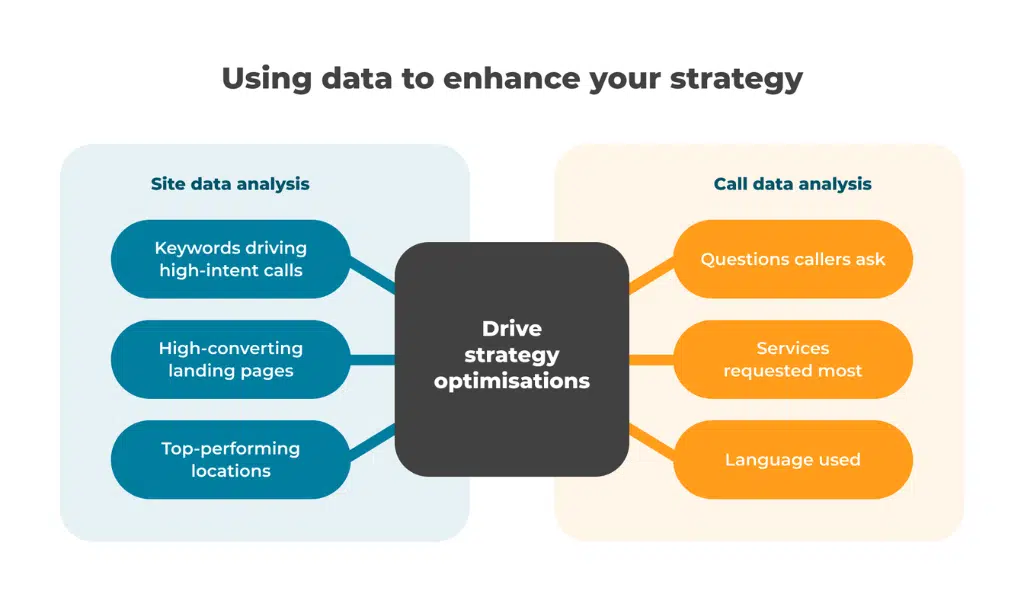
All the call data you gather really bolsters your search strategy. By analysing the keywords driving the best calls and combining them with your top-performing landing pages and locations, you’ll have an arsenal of insights at your disposal to optimise your content with. When you know where your calls are coming from and what outcomes they produce, you’ll form a feedback loop between marketing and sales teams. With a constant flow of insights, you can improve everyone’s respective efforts and activity well into the future.

Gain complete visibility into what happens before, during, and after the call. Using DNI, you can see exactly which channels, keywords, pages, and campaigns are driving your most valuable phone leads – not just clicks. With rich call data and attribution, you can optimise your SEO, media spend, and sales conversations with confidence.