Discover how private healthcare marketers can boost PPC performance in the AI search era


With answer engines swallowing search traffic and patient research behaviours changing, it’s vital for marketers to understand how their strategy is performing – in granular detail.
For private clinics and hospitals, being visible and engaging during the research stage of the patient journey is so important. That’s when potential patients need the most guidance, giving you the opportunity to build recognition and trust in search channels, which is vital for driving enquiries and revenue further down the line.
However, recent changes in search behaviour are making that more complicated. AI-assisted search is steadily growing in popularity and diverting traffic that would usually be delivered to clinic and hospital websites by organic search.
This shift demands adaptability from private healthcare marketers if they want to keep pace. Understanding your channel performance in depth – what’s working, where you can optimise, and which channels aren’t earning their keep – has never been more important. And it’s not enough to just know what’s happening; you need the tools to put that insight to work.
So let’s unpick the challenge in more depth and explore how you can ensure your search-focused campaigns are yielding the right results for your facility.
AI-driven search is transforming the way patients research
Around half of Google searches now feature an ‘AI Overview’ at the top of the results page, with one study finding that they’re most common on healthcare-related searches.
These summaries, which draw from multiple sources, are increasing the number of ‘zero click’ searches. Prospective patients can find what they’re looking for – like a list of local clinics offering their chosen procedure – without clicking through to a specific website.
Many are circumventing traditional SERPs entirely, turning to tools like ChatGPT, Perplexity, Copilot, and Gemini for help. These answer engines are particularly popular for ‘top of funnel’ queries. They’re offering increasingly detailed responses, and though they do drive some onward traffic, it currently accounts for only around 1%.
This has all conspired to make patients’ research journeys far more independent. “Those first few research steps are a vital opportunity for marketers to educate and reassure potential patients,” explains Natalie Sawford Smith, Client Success Manager at Mediahawk. “But instead of looking for informative websites to answer their questions about practitioners, procedures, and costs, they’re finding what they need right in the SERP or AI platform. And that’s leading to a downturn in traffic from organic search.”
“Those first few research steps are a vital opportunity for marketers to educate and reassure potential patients.” Natalie Sawford Smith, Client Success Manager at Mediahawk
As organic search dips, PPC spend is back on the rise
The logical choice to offset the decline of organic search traffic is to invest more in pay-per-click. At Mediahawk, we’re already seeing this from clients in multiple sectors. For example, a recent survey we conducted showed a rise in PPC spend and a broader spread of channels, including renewed interest in Bing PPC.
As you increase spend in any channel, it becomes increasingly important to track performance closely. When you’re working with high acquisition costs, expensive and competitive ad space, and often tight budgets, there’s no room for wasted budget. Knowing which campaigns to simply switch off can be as powerful as knowing where to make improvements.
But the changing search and PPC environment presents another opportunity too: to explore how you can drive traffic from the answer engines themselves.
Copilot and Perplexity both already feature ads within their results. And it’s looking increasingly likely that ChatGPT and potentially Gemini will soon follow suit. AI is adding more diversity to marketers’ channel mix, which is yet another reason to ensure you have a good handle on your data and how to use it to attract high-intent patients.
Optimise PPC channel performance with marketing attribution data
“The patient research cycle can be really complex,” says Natalie. “People often bounce around between different channels during their journey, making it difficult to pinpoint which techniques are delivering high-intent enquiries.”
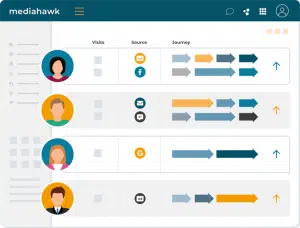
With the right analysis and marketing attribution tools, however, your data can offer a clear picture of which campaigns, ads, and even individual keywords catch the attention of potential patients. To take it one step further, technologies like call tracking can help trace prospects from a paid ad click all the way through to booking an appointment and converting to revenue. With more insight into a patient’s complete journey, you’ll be able to tell exactly what defines a high-intent patient.
Once you have this data, it’s all about feeding the information back into your PPC tools to refine your approach. “The more data you can provide, the more successful you’ll be at optimising search channel performance,” adds Natalie.
For example, you could create a custom audience in GA4 that’s shaped around your high-intent demographics. You might model it around people who converted after clicking through from a search for, say, sports-related injuries or cosmetic procedures. That custom audience can then provide signals for Google Ads, improving PPC targeting and retargeting to similar prospective patients.
This approach also works for Performance Max, if you want to apply your parameters across a broader spread of channels. If you’re experimenting with AI Max now it’s in beta, this can also lay a foundation for its adaptive campaigns, which expand to capture broader matches and even keywordless searches.
“The more data you can provide, the more successful you’ll be at optimising search channel performance.” Natalie Sawford Smith, Client Success Manager at Mediahawk
The world of PPC will continue to evolve
Patient behaviour is changing quickly and often in unexpected ways, spurred on by rapid advancements in what AI can offer as people research and enquire. Search and PPC may look a little different in this AI-assisted world, but these channels are no less important for private healthcare marketers.
With full visibility of the value each channel delivers, and the tools to adapt and experiment, marketers in the private healthcare space can match the pace of the sector and continue bringing in high-intent patients.
Explore more Mediahawk advice for reaching patients at the right moment in their journey in our practical guide for private healthcare marketers.

A practical guide for private healthcare marketers.