Buyers are researching in the dark. Here’s how dealers still win the sale.

From AI search to sale: Key takeaways from our automotive seminar
A car buyer asks an AI assistant which model suits their family. They spend weeks comparing, reading reviews and browsing Autotrader. Then they ring one or two dealers. By the time your phone rings, much of the journey has happened somewhere your reporting can’t see.
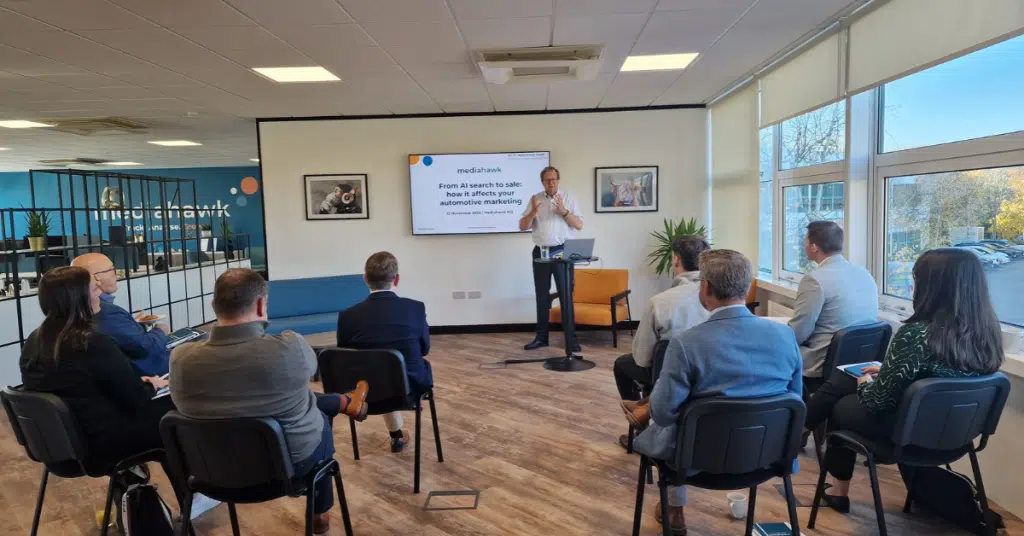
That was the thread running through our exclusive automotive seminar on 12 November 2026, when a small selection of dealer group marketers joined us at Mediahawk HQ in Milton Keynes. The theme of the day was ‘From AI search to sale’. Across three sessions, we looked at how AI is changing the way people research cars, and how dealers can prove which marketing actually sells them. Here’s what we covered:
The market is flat. The growth is in your calls.
I opened the day with findings from our Automotive trends report autumn/winter 2026. It draws on anonymised data from more than 27 million website visitors and over 4 million phone calls, between September 2025 and September 2026.
- Where visitors come from is shifting. Direct (32%) and PPC (31%) now bring in nearly two-thirds of website visitors. Organic search’s share fell by 19%, as AI Overviews push organic results further down the page.
- Google Business Profile still leads for calls, at 49% of the total, though that’s down from 56%.
- Call volumes are creeping up, but unevenly. Calls per dealer rose 6% year on year, yet only five of the 12 months beat September 2025.
My conclusion: in a flat market, growth comes from converting more of the calls you already get. I set out four actions:
- Convert more calls
- Turn browsers into buyers
- Understand the sources and outcomes of your calls
- Up your AI search game
Invisible research, visible results: staying on the AI shortlist.
Buyers now do most of their research and shortlisting before they ever contact a dealer. Faye Thomassen, Head of Marketing at Mediahawk, explained how to make sure your dealership is on the list when they do. Her five steps were:
- Answer the questions buyers ask AI. Create content that responds directly to them.
- Earn mentions on sources AI trusts. Where you are talked about matters as much as what you publish.
- Make reviews a KPI. Treat them as a measured target, not a nice-to-have.
- Keep your details identical everywhere. Inconsistent listings make you harder to trust and harder to find.
- Measure what you cannot click. Influence does not always leave a trail of visits, so find ways to track it.
From click to keys: where the ROI really sits.
Lawrence Cavill Grant, Head of Commercial at Mediahawk, showed where attribution breaks down. A buyer researches online for weeks, contacts one or two dealers by phone or form, and the sale is then logged in the dealer management system, away from the marketing data. The link between the two is lost.
Two things make that costly:
- Missed calls. According to AM Online, 20% of around 750,000 UK dealer sales calls went unanswered.
- Last-click reporting. Channels that start the journey, such as Autotrader and PPC, get no credit under last click. That makes them first in line when budgets are cut.
His advice: link every call and form to the car it became. That lets you report revenue by channel, not just leads by channel, and defend the spend that is really driving sales.
Next steps
The key takeaway from the day is don’t just count leads but understand the full customer journey and track your sales. Everything else, from AI visibility to answering more calls, gets easier to prioritise once you can see which channels sell cars.
Talk to our automotive team to see which of your channels are really selling cars.

Demand in the UK car market is steady, but buyer journeys are changing. AI search is answering more of buyers’ early questions, so they’re contacting dealerships much closer to a decision. With flat budgets, dealer groups need to know which channels bring in the calls that lead to sales.