Why conversion tracking could be the missing link in your marketing attribution model

Written by Faye Thomassen

Explore how conversion tracking can help you build a crystal-clear view of marketing attribution.
According to Marketing Week’s 2025 Language of Effectiveness survey, 60% of brand marketers say conversion rates are their most important trackable metric. But less than 40% measure whether their efforts contribute to business outcomes.
A strong conversion rate can be one of the ultimate signs that your marketing efforts are translating into real revenue, especially if you have the means to link them directly to sales. However, many brands aren’t tracking conversions effectively, creating gaps in their knowledge and leaving opportunities on the table.
Conversions aren’t all created equal
Conversions come in lots of different forms, and they aren’t all equally useful for building a meaningful picture of marketing success. (A shopper adding something to their basket can count as a conversion, for example, but that doesn’t always guarantee a sale.)
There’s no definitive list of ‘good’ conversions, though, because they’re not universal or static, which means:
- Different sources will often drive different types of conversions, with some indicating higher intent than others.
- Ideal conversions will change depending on the work you’re doing – if you’re focusing on brand awareness, you’ll be looking for flags that new prospects are entering your orbit.
- Conversion types that are a massive green flag for one brand, like a webinar registration, might not offer much value for another.
- You’ll want to pay attention to different conversion types as you optimise various areas of your strategy, like contact form fills when you’re evaluating your website flow.
- As customer behaviour shifts and you adjust your strategy, the conversions you want to prioritise likely will too.
The customer journey is punctuated by micro conversions
So conversion types aren’t equal, but that doesn’t mean they’re not all useful – if you treat them the right way.
Often, you’ll find that there are a number of ‘micro’ conversions that build up to the ones you really want to capture. A mailing list signup here, an ebook download there; these can indicate progression through the customer journey towards something more direct, like requesting a demo or a personalised quote.
Big conversions are typically more valuable in terms of sales and revenue, but less frequent (especially if you’re in a slow-moving industry where sales cycles can stretch on for months). So having a clear view of all these small indicators can be the difference between nurturing a prospect successfully and letting intent fizzle out into nothing.
How can you track conversions in such a complex environment?
This is all a lot to track. And it’s not just about getting the data together; you need effective ways to analyse it, too. Many strategies – and the infrastructure that underpins them – aren’t set up to unpick conversion rates in the level of granular detail marketers dream of having.
That might be down to a lack of integration and cohesion. It’s not unusual for form fills to be recorded by one tool while phone calls are logged by another and live chat sits in another platform entirely. Data ends up siloed, stored in a variety of formats, and impossible to integrate into one clear view.
Manually bringing all this data together is time-consuming and distracts marketers from useful work. On the other hand, curating a set of analytics capabilities to do it automatically can require technical resources many teams lack.
And then there’s still the workload of connecting the dots to follow prospect journeys from end to end, and making tweaks to cut out areas of friction and guide potential customers more effectively.
If you want to understand true ROI from your strategy – and the sources and techniques that are driving the most success – you need to be tracking conversions in the right way. That means finding the tools to connect data from your entire channel mix, extract insights, and reshape your strategy around what you need and what prospects want from you.
Effective conversion tracking is focused, flexible, and detailed
The ideal conversion tracking tool is simple to implement, seamlessly integrated with the rest of your marketing stack and, above all, comprehensive.
If there are conversions and context missing from your marketing attribution, you should look for a solution that:
- Combines conversion data from calls, forms, and live chat conversations to show how channels work in tandem
- Captures detailed information – such as names and requests – to support lead qualification
- Filters conversion types to separate micro actions from high-intent behaviours
- Ties into channel performance, sales data, and analytics to drive more complete marketing attribution
- Layers on top of existing tracking technologies without the need for additional tech expertise or complicated code
Tracking conversions in this level of detail is a crucial layer in complete marketing attribution. It breaks down one of the key silos for a more integrated stack and a view that’s clearer than ever.
Get the conversion clarity you’re looking for
See how Mediahawk’s Conversion Tracking feature gives marketers this much needed clarity, complementing broader analytics tools for a detailed, big-picture view of customer behaviours, channel performance, and marketing success.
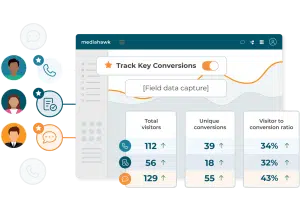
See how Mediahawk’s Conversion Tracking feature gives marketers this much needed clarity, complementing broader analytics tools for a detailed, big-picture view of customer behaviours, channel performance, and marketing success.