Care seekers’ journeys are changing. Are you ready to meet their needs?


Care demand is continuing to grow, but the journeys families take to find the right care home are changing rapidly. And Mediahawk’s latest anonymised data – analysed in full in our Care homes trends report: Autumn/Winter 2026 edition – reveals how that’s impacting marketing tactics and performance.
Paid search is more important than ever as care seekers carry out more research and increase their use of AI overviews and AI assistants. And that extra layer of research also means care seeker journeys are getting longer. While that might seem frustrating, it actually means you have more opportunities to build trust – and more moments you can make genuinely meaningful.
To make sure you deliver as many meaningful moments as possible, you need to know which calls drive move-ins to your care homes. And you need to understand what you can do to reach more care seekers at the right time.
So, let’s dive into the data and find out what care home marketers need to do to engage care seekers today.
AI search is transforming how care seekers do research
Care seekers are now more likely to visit a care home’s website multiple times before calling. In fact, while website visitor volumes rose by 26% compared to 2025, the number of calls originating from those websites only grew by 2%.
Care seekers are also arriving at your website in new ways, specifically from AI-assisted search. And the increasing use of AI overviews and AI assistants is heightening the competition for visibility. Using pay-per-click (PPC) can help you become more visible, but each call from PPC now costs around a third more than last year. That means you need to be able to prove your investments are actually driving move-ins.
“Paid search is replacing organic as a key source right now. We’re seeing a rise in PPC spend to buy back the visibility lost to search engine results pages that are crowded with extra features like AI overviews.”
– Faye Thomassen, Head of Marketing, Mediahawk
 “Paid search is replacing organic as a key source right now. We’re seeing a rise in PPC spend to buy back the visibility lost to search engine results pages that are crowded with extra features like AI overviews.”
The increase in care seekers using AI search also means you need to optimise for it. That might include:
- Keeping information on directories and other third-party sites up to date
- Adding FAQs to your web pages that AI search tools can directly pull from
- Encouraging those you’ve cared for to leave Google Reviews, providing independent validation AI tools can trust
In this longer, AI-assisted journey, knowing your audience is more important than ever. To get a real return on your PPC investments, you need to know which keywords and campaigns have the strongest influence on care seeker’s decisions. And you also need to incorporate these messages into the FAQs and third-party sites AI will use to generate answers to enquiries.
Harness seasonal trends to have the most meaningful conversations
While call volumes are generally up, with an 11% year-on-year increase in 2026, that growth isn’t linear. The volume of calls care homes are receiving fluctuates throughout the year, and keyword-level call tracking means we can see exactly what people want to talk about when volumes are high.
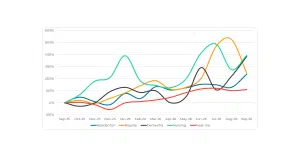
In 2026, call volumes saw a peak in January, and the keyword ‘nursing’ saw a sharp rise at the same time. This could indicate that many families are having to contend with worsening long-term health conditions or seasonal viruses during colder weather, and are looking for specific support to help them cope.
Call volumes also climbed in summer. At this time, the most frequent keywords we tracked were ‘nursing’, ‘respite’, and ‘dementia’. Families with both young children and elderly relatives often look for extra help in late July and August, as parents have less time to give to others who may need help. The data also suggests families use summer to look for more specific care options to suit their situation, such as to manage conditions like dementia.
Knowing broad seasonal trends can help you have the conversations care seekers want and need. But knowing what happens in your specific care homes is even more valuable.
Your own data is your most valuable tool
Making sure you’re being seen in relevant AI-assisted search results and creating meaningful conversations when people call have one thing in common:
The better you understand your care homes’ unique context, the more successful your initiatives will be.
Pay attention to the topics prospective residents bring up in the conversations they have with you. Using keyword-level call tracking can make spotting patterns easier. So, instead of going on gut feeling, you can show the decisions you’re making are backed by data. This can also provide insight into which conversations move care seekers along in their journey – and which have the biggest impact on move-ins.
You can then use the insight you collect to create fine-tuned messaging for your website, and inform PPC content that contributes to care seekers’ decisions to move in. Connecting your call tracking data to Google Marketing Platform, is also a great way to make sure you’re getting a complete picture of your marketing performance, so you can continue to do more of what works.
Summary
As care seekers undertake more research on their own before reaching out to talk, you need to make sure you’re giving them the right message, when and where they’re ready to engage with it. And that means understanding the decision-making journey your prospective residents are on.

Get your copy of Care homes trends report: Autumn/Winter 2026 edition to discover:
- The biggest trends care home marketers need to know
- Expert analysis of what the latest developments really mean
- Actions you can take to boost your marketing performance