AI search visibility for car dealers: how to get recommended, not just ranked


- How car buyers find dealerships now
- 1: Treat reviews as part of the sales process
- 2: Keep your dealership’s details identical everywhere
- 3: Earn the conversations you can’t control
- 4: Publish the answers your sales team gives every day
- 5: Let your creative do the targeting on Meta
- 6: Give Google Ads better data, not more campaigns
- 7: Respond quickly when the enquiry lands
- Measuring visibility you can’t see in a report
- What this means for your dealership
Car buyers are now asking AI tools like ChatGPT which dealer to trust before they ever visit a car website. Here’s how dealerships can become the answer and turn that visibility into phone calls and showroom visits.
For years, a dealership’s digital visibility came down to one question: where do we rank on Google? That question still matters, but it no longer tells the whole story.
At 67 Degrees, we provide the performance platform that dealer groups, franchises, and independents across the UK run their digital business on, from websites and stock to leads and marketing. And across that platform, we’re seeing the same pattern emerge…
Buyers still research heavily, but more of that research now happens in places a dealer doesn’t own. These are places such as AI assistants (like ChatGPT), Google’s AI Overviews, review platforms, forums (like Reddit) and social media video (like TikTok).
As a result, a buyer may get a shortlist of dealers, or even a single recommended dealer, without ever clicking a search result. So how do you make sure your dealership is the one on that list? And how do you make sure the interest it creates turns into a call your team can actually convert? In this article, we cover both of these questions.
How car buyers find dealerships now
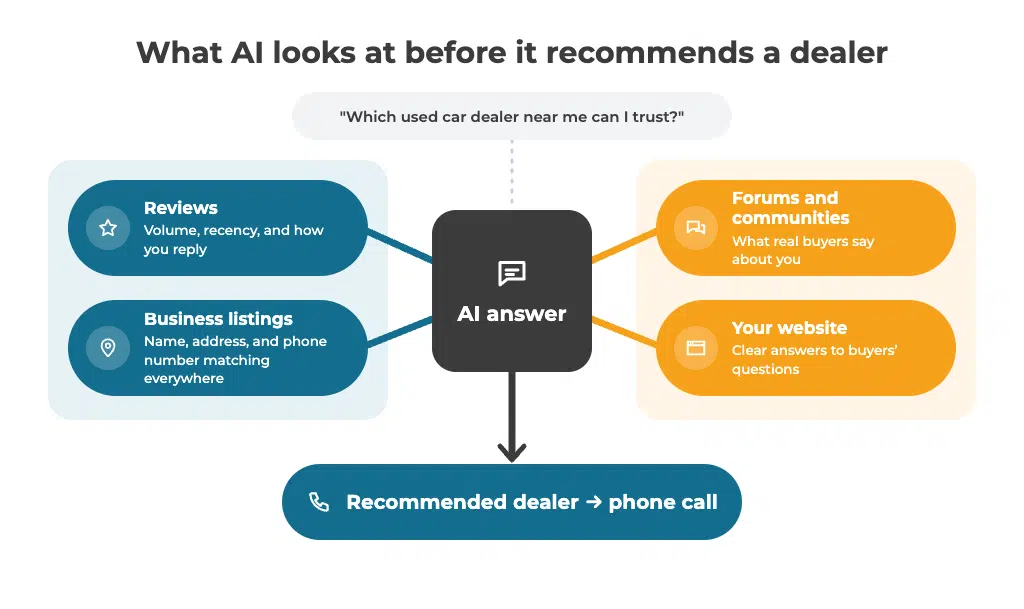
Think about the questions a buyer would ask before they get in touch. Questions like: Which family SUV suits a tight budget? Is a plug-in hybrid worth it for my commute? Is this dealer reliable? Car buyers are increasingly putting those questions into ChatGPT, Gemini, Perplexity or Google’s AI Mode, and get a single, confident answer back.
The answer provided is built from whatever information the AI tool can find online and trust about you. This includes your customer reviews, your business listings, what people say about you on forums, and how clearly your own website explains things. For example, a strong homepage ranking helps, but it’s only one factor among many others that affect your AI visibility.
Ultimately, this has two consequences for car dealers. First, the goal shifts from ranking to being cited and recommended. Second, buyers who do get in touch are doing so further along in their decision-making process. This means they’ve already compared, validated and shortlisted their choice of car(s). So, when someone from your dealership picks up the phone at this stage, it’s often a call worth a great deal to your business.
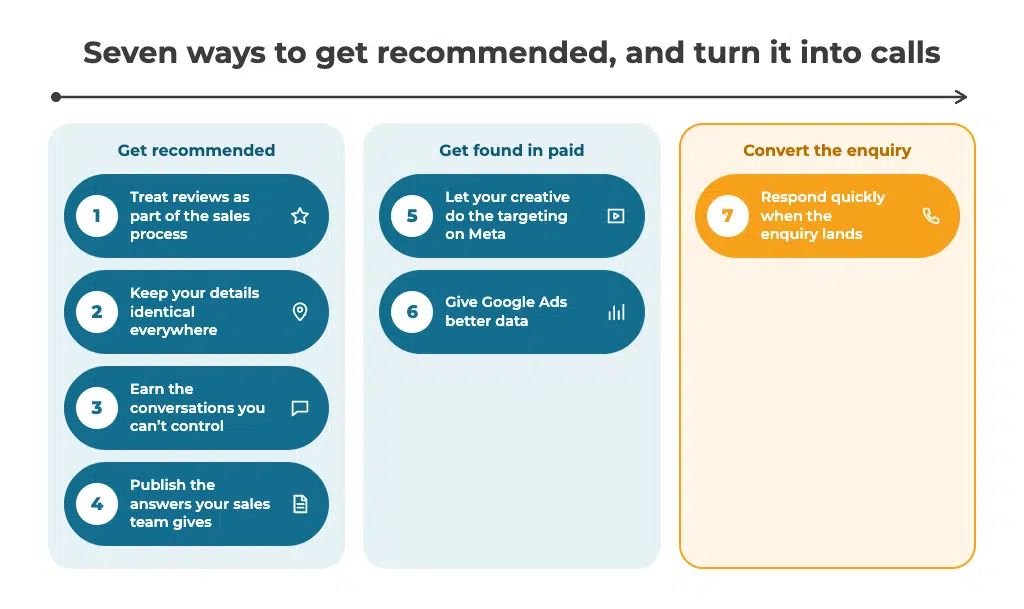
Here are seven areas we’d focus on to make sure that call comes to you:
1: Treat reviews as part of the sales process
When an AI tool or Google’s local results decide which dealer to suggest for a search like “used Audi dealer near me”, dealership reviews play a very important part. Of course, the volume of reviews matters, but so do their recency and the tone of your replies. For example, a dealership with a steady stream of fresh, detailed reviews looks active and trustworthy, but one whose latest review is eight months old looks risky to potential customers.
In our experience, a well-kept Google Business Profile (GBP) backed by consistent recent reviews does more for local search results and AI visibility than most on-page website tweaks do. The dealers who do this well build review requests into the handover, so every happy customer is asked at the moment they’re most likely to say yes.
A few daily habits can make all the difference:
- Ask every customer, ideally on the day they collect their car.
- Reply to every review, including the critical ones, calmly and specifically.
- Keep your Google Business Profile complete and up-to-date with opening hours, services, photos and stock categories.
Reviews from your happy customers also shape the journey for other potential buyers. Someone who has just read twenty recent five-star reviews is far more likely to call you than keep browsing for other options.
2: Keep your dealership’s details identical everywhere
AI tools cross-check information. If your dealership name, address, and phone number (NAP data) appear one way on Google, another on Apple Maps, and a third on an automotive directory, that inconsistency reduces confidence in your business. And less confidence in your business means fewer recommendations in AI.
Audit every listing you can find and make them match exactly, down to abbreviations and the format of the phone number. For multi-site dealership groups, give each location its own properly written page on your website, with that site’s details, team, opening hours and directions. To help boost your AI presence, mentions in local press and reputable directories build your brand trust even further.
There’s one detail worth planning carefully here. If you use call tracking, keep a single consistent main number on your listings and let dynamic numbers do their work on your website. That way you protect listing consistency and still see which channels are making the phone ring where enquiries are concerned.
3: Earn the conversations you can’t control
Forums like Reddit have become a major source of information for AI tools because they’re full of honest ownership stories and real buying experiences. To see for yourself, search terms like ‘best used EV UK Reddit’ or ‘[brand] reliable Reddit’ and you’ll see how much these threads shape opinion, both directly and through the AI summaries built from them.
You can’t manage these conversations, and you shouldn’t try to manipulate them. This is because posting disguised as promotion tends to backfire for a business pretty quickly. Instead, give customers a buying experience they’ll describe positively on a forum when someone asks for a car dealer recommendation.
In doing so, consider how transparent pricing, a straightforward handover and an aftersales team that answers the phone can positively impact a customer’s journey.
It also helps to know what people are saying about your business and the manufacturers you represent. Spend time reading the forum threads that mention your brands and your area. They’re an open source of objections, worries and questions that your marketing should be addressing.
4: Publish the answers your sales team gives every day
AI tools pull from online content that answers questions clearly. A page on your website that properly explains whether a plug-in hybrid or a full EV suits a 40-mile daily commute is far more likely to be cited than a page built around a keyword.
Useful content formats for dealers include:
- FAQs about car finance, part exchange, warranties and delivery.
- Model comparison and buying guides.
- EV and hybrid ownership explainers.
- Case studies with named vehicles and real outcomes.
The best source of topics is the conversations your team already has with customers on a daily basis. Your sales staff answer the same questions every day, on the showroom floor and on the phone. If you use speech analytics, call recordings and transcripts show the exact words buyers use before they commit, which makes them ideal material for content.
AI can speed up your team’s writing in this process. Tools like Claude or ChatGPT will happily draft a stock description, a guide or a set of FAQs. But remember that unedited AI copy tends to sound generic, and generic content doesn’t earn citations or trust. Use AI for the first draft, then rewrite it in your voice and check every fact first.
Finally, make sure your website provider builds in structured data (schema markup) as standard. It helps search engines and AI tools understand what each page covers, from vehicle details to opening hours.
5: Let your creative do the targeting on Meta
But online visibility isn’t only achieved organically. On Facebook and Instagram, Meta’s recent changes have reduced the influence of detailed manual audience targeting. The ad itself (the video, the opening seconds and the message) now does most of the work of telling Meta’s algorithm who to show it to. A strong ad finds its audience; a weak one won’t, no matter how carefully you set the targeting.
For dealers, that means:
- Leading with video, and making the first three seconds count.
- Running several creative variations at once, so the algorithm can learn what works.
- Favouring real footage of your stock, your team and your customers over polished but generic imagery.
If your Meta ads drive calls as well as form fills, make sure those calls are tracked back to the campaign. Otherwise, you’ll undervalue the creative that’s actually working.
6: Give Google Ads better data, not more campaigns
Google Ads is now heavily automated, and the best-performing accounts aren’t the ones with the most complex structures. They’re the ones giving Google the most accurate picture of what a good lead looks like for your dealership. That means connecting enhanced conversions, importing offline conversions and linking your CRM, so Google learns which enquiries became sales.
Calls belong in that picture too. For many dealers, the phone is where a large share of serious enquiries come from, and if calls aren’t fed back into Google Ads, the algorithm is optimising on only part of the story. Tools like Mediahawk’s Sales Matching product take this a step further by connecting enquiries to actual vehicle sales.
It’s also worth checking how your paid and organic search work together. Where you already rank strongly for a term, you may be paying for clicks you’d have won anyway. Joining up your SEO and PPC strategies helps you spend where it makes a real difference.
7: Respond quickly when the enquiry lands
All of this visibility is wasted if the enquiry goes unanswered. Buyers who’ve done their research expect a prompt response, and if they don’t get one, the next dealer on their shortlist is only a call away.
This is where AI is proving genuinely useful behind the scenes:
- Out-of-hours response. Chat tools on dealer websites can answer questions about stock, finance and availability at 9pm on a Sunday, rather than leaving a buyer waiting until Monday.
- Lead prioritisation. By combining browsing behaviour, engagement, and CRM history, AI lead scoring can flag which enquiries are closest to buying a car, so your team calls those first instead of working down the list in arrival order.
- Call handling. Routing calls to the right person and making sure missed calls are spotted and returned quickly protects the high-intent enquiries you’ve worked hardest to earn. Mediahawk’s advanced call handling is built for exactly this.
But what AI doesn’t do is close the sale – that’s still down to you. This is because buyers still want to feel understood by a real person they can trust. The dealers getting the most from AI use it to free up their team and provide better information, so the human conversation happens sooner and more consistently.
Measuring visibility you can’t see in a report
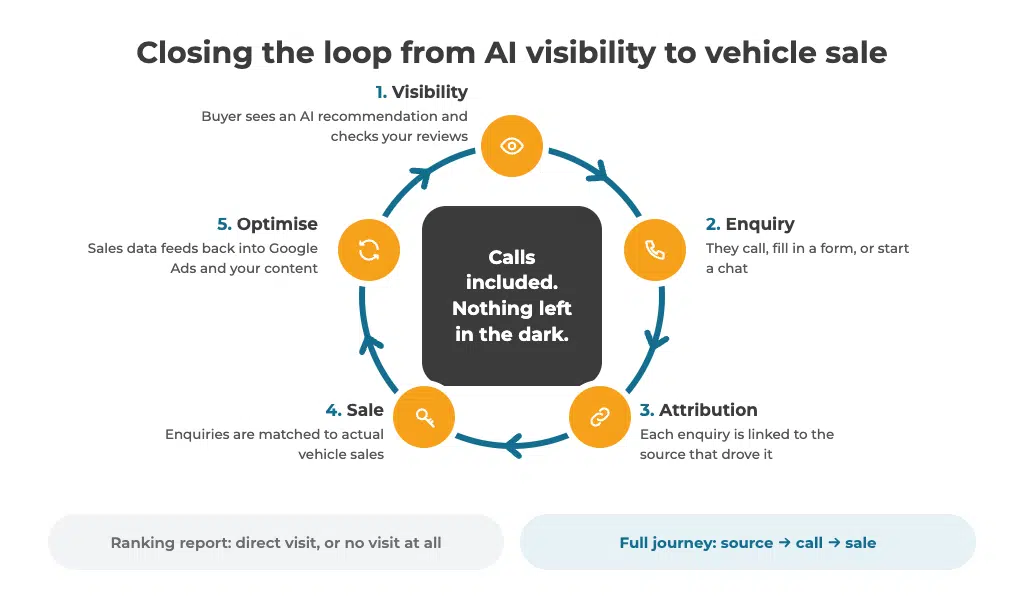
One of the hardest parts of AI-era visibility is proving it’s working. When a buyer reads an AI recommendation, checks your reviews, and then rings the showroom, a traditional analytics report may show only a direct visit, or no visit at all.
That’s why joined-up measurement matters more than ever. Dealers who can see the full journey are in a much stronger position to know which efforts deserve more budget.
That means tracking calls alongside forms and chats, attributing each one to its source, and following it through to a sale. Listening to what callers say also really helps. So when buyers mention that they found you through a recommendation or read about you online, that’s a signal no ranking report will give you.
What this means for your dealership
Car buyers still want the same things they always used to. That’s a dealer they can trust, the right car, and a team others speak well of. What’s changed is where they look for those reassurances. AI tools, reviews, forums, local listings and social video now shape the shortlist as much as a website ranking does.
The dealers who are profitable in the next couple of years will be the ones who implement an AI strategy into the business for maximum opportunity. To help you on that journey, here are five points to get you started:
- Show up credibly wherever buyers are researching, not just on page one of Google.
- Make reviews and consistent listings part of everyday operations.
- Publish genuinely useful answers on your website to the questions buyers actually ask.
- Give ad platforms better creative and better data.
- Respond quickly and measure every enquiry, including calls, through to a sale.
Get those right, and you won’t just be visible. You’ll be recommended, and the calls that follow will be worth answering.